Finding breaks, sharp bends, poor splices, and connector faults is much easier with the right visual fault locator. The 10 options in this roundup cover compact pen-style testers, adapter kits, rechargeable models, and longer-range tools for telecom and network work.
Use the buying guide below to compare testing range, connector support, visibility, power design, and practical features before choosing a visual fault locator for your cable-testing needs.
Best 10 Visual Fault Locator Fiber Optic Testers Picks for 2026
Best All-in-One Kit
Fiber Optic Cable Troubleshoot Kit

- Includes five adapters and three patch cords
- Tests ST, SC, FC, and LC setups
- Supports single-mode and multimode cables
Best For: Panel-side troubleshooting and varied connector types
Best Compact Maintenance Pick

- One-button operation for quick checks
- Supports SC, ST, FC, and LC connectors
- Aluminum alloy housing and carrying pouch
Best For: Routine installation, repair, and continuity testing
Best Green-Light Option

- 510nm green light for enhanced visibility
- Advertised 15–30 km detection range
- IP54 aluminum body for field conditions
Best For: Longer runs and demanding telecom field work
Best Long-Range Red Laser

- 650nm red laser highlights fiber faults
- Claims detection up to 30 km
- Aluminum, anti-ESD portable construction
Best For: Long-range network troubleshooting with common connectors
Best All-Around Fiber Tracing

- Finds breaks, bends, cracks, and poor connections
- Supports ST, SC, FC, and LC interfaces
- Rugged aluminum and stainless steel construction
Best For: General fiber maintenance and continuity testing
Longest-Rated Detection Range

- Advertised detection distance up to 89–100 km
- Universal connector supports common interfaces
- Includes low-battery and constant-output functions
Best For: Long-distance fiber tracing in field work
Best Portable Kit

- 650nm red light highlights common fiber faults
- Supports ST, SC, FC, and LC connectors
- Includes a carrying pouch for field use
Best For: Portable telecom and data-center troubleshooting
Long-Range Choice
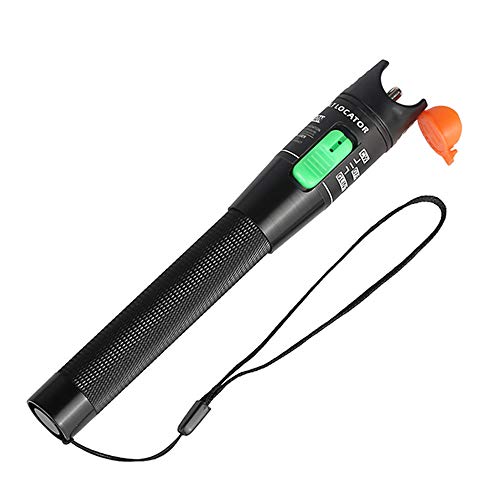
- Detection range rated up to 30-50 km
- 2.5 mm interface for ST, SC, FC, and LC
- AA-powered with low-battery warning
Best For: Field fiber tracing and long-distance fault checks
Rechargeable Field Pick

- Continuous and flashing laser modes
- Integrated LED flashlight for dark work areas
- Rechargeable 400 mAh battery
Best For: Portable troubleshooting and mixed connector maintenance
Kit Value Pick

- Two pens for backup or team use
- Supports single-mode and multimode cables
- Aluminum housing with carrying pouch
Best For: Installers and teams needing a simple VFL kit
Best All-in-One Kit – Fiber Optic Cable Troubleshoot Kit
This adapter-rich kit is a practical choice among visual fault locator fiber optic testers when you need to inspect several common connector types and troubleshoot fibers without removing them from a distribution panel. It detects breaks, bends, cracks, and poor connections, and includes patch cords for added flexibility.
Best For: Field technicians who need a portable VFL kit with adapters and patch cords for panel-side troubleshooting.
Pros:
- Supports ST, SC, and FC interfaces through its 2.5mm universal connector.
- Includes FC, ST, LC, and SC adapters plus three short patch cords.
- Works with both single-mode and multimode cables.
- Backed by 24 months of after-sales service.
Cons:
- 2AA batteries are not included.
- LC testing requires the included FC male-to-LC female adapter.
Its strongest advantage is the included accessory set, making it more versatile than a bare locator. Choose it if connector coverage and panel troubleshooting matter more than a specialized long-range specification.
Best Compact Maintenance Pick – FC/LC Adapter VFL Kit
This compact visual fault locator fiber optic tester uses a visible red light to help identify breaks, sharp bends, damaged connectors, and routing problems. Its universal interface and simple one-button operation make it suitable for routine installation, repair, and continuity checks.
Best For: Technicians who want a straightforward, portable VFL for mixed connector environments and everyday maintenance.
Pros:
- Compatible with SC, ST, FC, and LC fiber connectors.
- Designed for both single-mode and multimode networks.
- Aluminum alloy housing suits repeated field use.
- Includes a carrying pouch and has a two-year limited warranty with lifetime technical support.
Cons:
- The listing identifies the included component as the visual fault locator, so accessory coverage is less extensive than a full patch-cord kit.
- Battery powered, with no battery details supplied in the notes.
This is a sensible general-purpose option when ease of use and portability are priorities. Its broad connector compatibility covers common network work without adding complicated controls.
Best Green-Light Option – 15–30 km Green Light VFL
For technicians comparing visual fault locator fiber optic testers for demanding or longer-reach work, this green-light model emphasizes visibility and range. Its 510nm light is designed to provide stronger penetration than red light, while the rugged, IP54-rated body is suited to outdoor and industrial environments.
Best For: Telecom, data-center, and FTTH technicians working across longer fiber runs or challenging field conditions.
Pros:
- Uses a 510nm green light intended to improve visibility in dark or complex environments.
- Advertised detection range of 15–30 km.
- Compatible with SC, FC, ST, and LC interfaces.
- Lightweight 106g aluminum body with IP54 protection and a -20°C to 60°C operating range.
Cons:
- Includes the VFL only, with no adapter kit or patch cords listed.
- Its sub-5mW Class IIIA output still requires appropriate laser-safety handling.
This model stands out for its combination of green-light visibility, claimed long reach, and environmental protection. It is a strong fit for field work where portability alone is not enough.
Best Long-Range Red Laser – 30km VFL Fiber Optic Tester
This 650nm red-laser visual fault locator fiber optic tester is designed to reveal breaks, weak connections, bends, and cracks across fiber links. Its standard 2.5mm connector supports common ST, SC, and FC interfaces, while the compact aluminum design is made for portable field use.
Best For: Network technicians who need a red-light VFL with a claimed 30km detection distance and durable, portable construction.
Pros:
- High-intensity 650nm red laser helps make fault points visible.
- Claims detection over distances of up to 30 kilometers.
- Works with ST, SC, and FC interfaces through the standard 2.5mm connector.
- Features an aluminum alloy body, stainless steel tip, and anti-ESD design.
Cons:
- Battery is not included.
- LC compatibility is not listed as direct; the included FC male-to-LC female adapter is noted in the specifications.
- No additional patch cords are listed.
Its main appeal is the combination of long-distance fault detection and a field-oriented build. Consider it when a red laser and broad common-connector support fit your workflow, while remembering to supply the required battery.
Best All-Around Fiber Tracing – Moocci Visual Fault Locator
For technicians comparing visual fault locator fiber optic testers, the Moocci model offers a practical combination of fault visibility, connector flexibility, and field-friendly construction. It is designed to help identify breaks, poor connections, bends, and cracks while supporting tracing, routing, and continuity checks.
Best For: General fiber maintenance, splice preparation, and continuity testing across common connector types.
Pros:
- Helps reveal breakpoints, bends, cracks, and poor connections with a bright visible glow.
- 2.5mm universal connector supports ST, SC, FC, and LC interfaces with the included FC-to-LC adapter.
- Includes constant output, low-battery warning, and long-distance detection features.
- Stainless steel head and aluminum body provide crash- and dust-resistant construction.
Cons:
- Requires two AA batteries.
- The supplied notes do not specify an exact maximum detection distance.
This Moocci tester is a versatile choice when connector compatibility and durable field use matter more than a narrowly specified range. Its broad testing functions make it suitable for routine troubleshooting and fiber identification.
Longest-Rated Detection Range – HT-80 80–100KM VFL Tester
Visual Fault Locator, 80-100KM Fiber Optic Cable Tester Meter VFL Red Light Pen Light Source Testers
Check Price On AmazonThis visual fault locator fiber optic tester is aimed at users who prioritize a long stated detection distance. The HT-80 combines red-light fault identification with a universal connector, constant output power, battery monitoring, and a compact pen-style form.
Best For: Long-distance fiber tracing and field troubleshooting where the advertised 80–100 km range is useful.
Pros:
- Advertised output distance reaches up to 89–100 kilometers.
- Helps locate breaks, bends, cracks, and poor connections using visible red light.
- 2.5mm universal connector is designed for ST, SC, FC, and LC interfaces.
- Aluminum body and stainless steel head provide crash- and dust-resistant protection.
Cons:
- Requires two AA batteries.
- The supplied notes do not include a carrying case or additional adapter beyond the listed connector design.
The HT-80 stands out primarily for its high advertised range. It is a sensible option for technicians who want long-distance detection alongside standard connector compatibility and basic field-test features.
Best Portable Kit – 50KM VFL Tester with Case
Among visual fault locator fiber optic testers, this 50KM kit is a convenient choice for technicians who want a portable tester with broad connector compatibility and a carrying pouch. Its 650nm red light is designed to highlight breaks, bends, and loose connections during troubleshooting.
Best For: Telecom maintenance, data-center work, and technicians who need an organized field-ready kit.
Pros:
- 650nm ±10nm red light helps identify breaks, bends, and loose connections.
- 2.5mm universal connector and LC adapter support ST, SC, FC, and LC connectors.
- Pen-style lightweight design includes a low-battery alert and carrying pouch.
- Stainless steel tip and aluminum body resist drops, dust, and electrostatic discharge.
Cons:
- Two AA batteries are required but not included.
- Its stated 50KM range is lower than the 80–100KM rating of the HT-80 option.
This kit balances portability, connector flexibility, and clear fault illumination. The included pouch and compact design make it especially practical for technicians moving between telecom, network, and data-center jobs.
Long-Range Choice – 30-50KM Visual Fault Locator
Visual Fault Locator, 30-50KM Fiber Optic Cable Tester Meter VFL Red Light Pen Light Source Testers
Check Price On AmazonFor shoppers comparing visual fault locator fiber optic testers, this model emphasizes long-distance detection, steady output, and broad connector compatibility. Its red light can help reveal breaks, bends, cracks, and poor connections during fiber tracing, routing, and continuity checks.
Best For: Field technicians who need a battery-powered VFL with extended range and support for common fiber interfaces.
Pros:
- Rated for output distances up to 30-50 km.
- Supports ST, SC, FC, and LC interfaces through its 2.5 mm universal connector.
- Includes constant output power, low-battery warning, and long battery life features.
- Uses two convenient AA batteries.
Cons:
- Uses disposable AA batteries rather than a built-in rechargeable battery.
- The supplied information does not list a carrying case or additional accessories.
Choose this tester when maximum stated detection distance and straightforward field operation matter most. Its durable-looking metal style and compact 110 g design also make it practical for routine maintenance work.
Rechargeable Field Pick – 30KM 2-in-1 VFL Tester
Among visual fault locator fiber optic testers, this 2-in-1 model combines a 30 km red-laser VFL with a built-in LED flashlight. Continuous and flashing modes make it useful for locating breaks, sharp bends, weak splices, and cracks in dim work areas.
Best For: Installers and maintenance technicians who prefer rechargeable power and an integrated light for server rooms, patch panels, or outdoor jobs.
Pros:
- Offers continuous and flashing fault-finding modes.
- Provides stated detection distance up to 30 km with a 650 nm laser.
- Built-in LED flashlight supports work in dark locations.
- Rechargeable 400 mAh battery avoids routine disposable-battery replacement.
Cons:
- Its stated range is shorter than the 30-50 km model in this roundup.
- The supplied information does not specify a protective case or detailed charging time.
This is a convenient choice for mobile troubleshooting because it combines fault location, illumination, and USB-rechargeable operation in a lightweight body. The included FC male to LC female adapter further suits mixed-connector maintenance tasks.
Kit Value Pick – 2-Pack Fiber Optic VFL Pens
This two-piece option is a practical entry in visual fault locator fiber optic testers for technicians who want a spare or a second unit. The red light helps trace fiber paths, check continuity, and identify breaks, bends, damaged connectors, and routing problems.
Best For: Teams, installers, and maintenance users who want two compact VFL pens for single-mode and multimode cable work.
Pros:
- Includes two visual fault locator pens for shared use or backup.
- Works with single-mode and multimode fiber networks.
- Offers one-button operation for simple continuity and fault checks.
- Aluminum alloy housing is designed for repeated field use, with a carrying pouch included.
Cons:
- The supplied notes specify compatibility with SC, ST, and FC connectors, while LC support is listed in the product details but not the main compatibility bullet.
- Battery type and detection distance are not specified in the supplied information.
Consider this kit when quantity, simple operation, and portability are higher priorities than advanced power features. The included pouch, two-pen format, and stated two-year limited warranty with lifetime technical support add practical value for maintenance teams.
How We Picked These Visual Fault Locator Fiber Optic Testers
We focused on the features that matter during real fiber troubleshooting: stated detection range, connector compatibility, light-source design, power options, portability, and included adapters. The selection includes models for basic continuity checks, network installation, single-mode cable work, multimode testing, and field service.
Because listed specifications can vary by cable condition, connector cleanliness, fiber type, and ambient light, treat maximum distance as a guideline rather than a guaranteed result. A practical tester should also be simple to connect, easy to see in daylight, and durable enough for repeated handling.
Quick Comparison
| Best For | What to Prioritize | Useful Options in This Roundup |
|---|---|---|
| Basic home or workshop troubleshooting | Simple operation, low cost, common adapters | Compact VFL pens and starter kits |
| Mixed connector networks | SC, ST, FC, and LC compatibility | Adapter-inclusive tester kits |
| Long single-mode runs | Higher stated range and stable output | 30–100 km-rated models |
| Frequent field service | Rechargeable power, rugged handling, visible output | Rechargeable and 2-in-1 designs |
Key Buying Factors for Visual Fault Locator Fiber Optic Testers
Range and Fiber Type
Choose a range suited to the longest cable you normally test, but remember that bends and visible breaks may be detectable well before the maximum advertised distance. Confirm whether the device is intended for single-mode, multimode, or both.
Connector Compatibility
SC, ST, FC, and LC are common, but one tester may not accept every connector without an adapter. An included FC-to-LC adapter can save time and prevent compatibility issues. Check whether adapters are removable and whether replacement pieces are readily available.
Output, Visibility, and Safety
Red laser output is widely used for locating breaks and bends, while green light can be easier to see in some conditions. Review the stated power class and follow laser-safety guidance. Never look directly into an active fiber or connector.
Power and Field Practicality
Battery-powered pens are convenient for occasional testing, while rechargeable models reduce disposable-battery use during frequent service calls. Look for a protective cap, clear controls, a sturdy housing, and an indicator that shows operating status.
Who Should Buy Which Visual Fault Locator Fiber Optic Testers?
Choose a basic pen or starter kit if you need an affordable tool for occasional continuity checks, patch-cord troubleshooting, or home and workshop projects.
Choose an adapter-rich model if your work involves several connector types. Broad SC, ST, FC, and LC support is especially useful for installers and network technicians handling mixed infrastructure.
Choose a longer-range tester if you regularly inspect extended single-mode runs in telecom, campus, or outside-plant environments. Verify the manufacturer’s range claims against your cable type and test conditions.
Choose a rechargeable or combination tool if portability and repeated field use matter most. An integrated work light or rechargeable battery can reduce the number of tools you carry, though it is still worth checking charging behavior and spare-power options.