Choosing among KVM extenders for laptops can simplify a desk shared between a laptop, desktop, monitors, keyboard, and mouse. The right model can place your computer in another room while keeping control and display connections responsive.
This roundup compares 10 options across resolution, transmission distance, connectivity, monitor support, and installation style so you can match the extender to your workspace.
Best 10 Kvm Extenders for Laptops Picks for 2026
Long-Range KVM Pick

- Reaches up to 393 feet over Cat6 or better
- Supports 4K@30Hz with HDMI loop-out
- Includes USB KVM, audio, and IR extension
Best For: Remote laptop or PC control over long cable runs
Dual-Laptop Desk Setup

- Switches two laptops across two monitors
- Supports dual 4K@60Hz MST output
- Adds four USB 3.2 ports and 100W PD input
Best For: Dual-monitor workstations using compatible USB-C laptops
Premium Video Extension
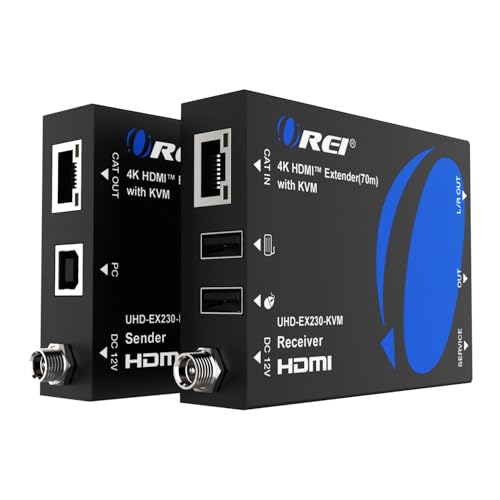
- Extends 4K@60Hz up to 230 feet
- Supports HDR formats and HDCP 2.2
- Includes loop-out, USB KVM, audio, and EDID pass-through
Best For: 4K laptop or PC extension with HDR-capable displays
High-Resolution Hybrid Setup
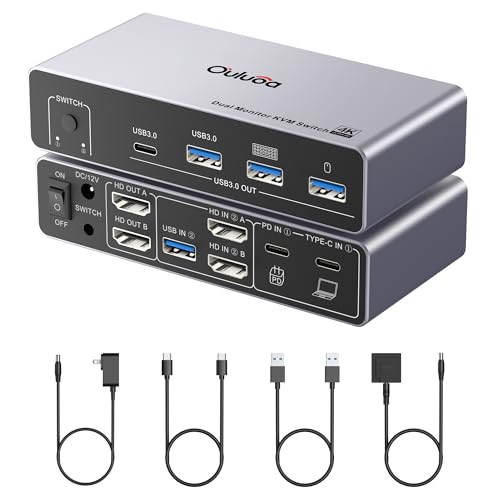
- Switches one desktop and one laptop
- Supports dual HDMI monitors and desktop-side 8K@60Hz
- Adds four USB ports and 100W PD charging
Best For: Windows desktop-and-laptop workstations with dual displays
Best for IP-Network Flexibility

- 4K video and USB control over long Cat cable runs
- Can use compatible Gigabit Ethernet switches
- Remote USB hub with three receiver-side ports
Best For: Networked server rooms and distributed workstations
Best for Simple 4K Point-to-Point Links

- Extends 4K HDMI and USB up to 230 feet
- HDMI loop-out supports local monitoring
- EDID control and PoC simplify installation
Best For: Office, classroom, and control-room setups
Best for Maximum Range on a Budget

- Reaches up to 984 feet over Cat5e or Cat6
- Supports up to 1920×1200 at 60Hz
- Remote keyboard and mouse control included
Best For: Long-distance VGA workstations and legacy PCs
Best Overall

- Extends HDMI, audio, and USB up to 390 feet over Cat5e.
- Supports 4K@30Hz and 7.1-channel audio.
- Works with Windows, macOS, and Linux without drivers.
Best For: Professional networked workstations and server-room setups
Best Budget Option

- Sends 1080p video up to 394 feet.
- Adds HDMI loop-out for local monitoring.
- Supports standard USB keyboards and mice.
Best For: Simple Full HD classrooms, offices, and home theaters
Long-Range KVM Pick – 4K HDMI KVM Extender
For shoppers comparing kvm extenders for laptops, this HDMI-over-Cat6 model is a practical choice when the computer needs to stay in one room while the display and controls move to another. It supports up to 4K at 30Hz across distances up to 393 feet using Cat6, Cat6a, or Cat7 cable.
Best For: Extending a laptop or PC to a remote monitor with keyboard, mouse, audio, and source-device control.
Pros:
- Extends HDMI and USB KVM signals up to 393 feet.
- Supports 4K@30Hz and includes HDMI loop-out for a local display.
- Provides audio outputs and IR control at both ends.
- Works with laptops, PCs, DVRs, NVRs, projectors, and gaming devices.
Cons:
- Maximum listed resolution is 4K@30Hz rather than 4K@60Hz.
- Requires a separately installed Cat6, Cat6a, or Cat7 cable between locations.
This extender emphasizes distance and flexible installation, making it suitable for offices, classrooms, surveillance setups, and home theaters where remote computer access matters more than high-refresh-rate video.
Dual-Laptop Desk Setup – 2-Monitor USB-C KVM Dock
This USB-C KVM dock is designed for a two-laptop workstation, letting you share two external monitors and four USB peripherals from one compact unit. It is a strong option among kvm extenders for laptops when switching between work and personal systems is the main priority.
Best For: Users who want to switch two compatible laptops across dual monitors, keyboard, mouse, and other USB devices.
Pros:
- Switches between two laptops and shares two monitors plus four USB 3.2 ports.
- Supports dual 4K@60Hz output through MST on compatible systems.
- Includes a 100W PD input capable of charging each laptop at up to 45W.
- Works with Windows, macOS, Linux, and Chrome OS.
Cons:
- Mac OS supports mirror mode only, not extended display mode.
- Laptops must support USB-C DP Alt Mode, video, data, and PD.
- Requires an 11th-generation-or-newer laptop CPU according to the supplied requirements.
With high-speed USB connectivity and wired remote switching, this model suits a modern dual-laptop desk. Check laptop port support and the included cable requirements before buying.
Premium Video Extension – OREI 4K HDMI KVM Extender
The OREI EX-230PRO-KVM is a good fit for buyers seeking kvm extenders for laptops with sharper 4K video and remote keyboard-and-mouse access. It sends HDMI up to 230 feet over Cat6 or Cat7 cable and supports 4K at 60Hz.
Best For: Extending a laptop or PC to a remote 4K display while retaining local video, USB KVM, and analog audio access.
Pros:
- Transmits 4K@60Hz up to 230 feet over Cat6 or Cat7.
- Supports HDR formats including HDR10, HDR10+, Dolby Vision, and HLG.
- Includes HDMI loop-out, USB KVM, EDID pass-through, and receiver-side audio extraction.
- Backed by a 1-year warranty and supplied with a power adapter and manual.
Cons:
- Its 230-foot range is shorter than some long-distance HDMI extenders.
- Requires compatible LAN cabling and a wired installation between sender and receiver.
This OREI model balances high-quality video with useful remote-control features. It is especially appealing for presentation, entertainment, or workstation setups where 4K60 and HDR support are important.
High-Resolution Hybrid Setup – 8K USB-C KVM Dock
This USB-C KVM dock targets a mixed desktop-and-laptop setup, sharing two HDMI monitors and USB peripherals between both computers. For shoppers evaluating kvm extenders for laptops, it combines laptop connectivity, dual-display support, and 100W PD charging in one desktop-oriented unit.
Best For: Windows users who want one keyboard, mouse, dual HDMI monitors, and shared peripherals for a desktop and laptop.
Pros:
- Controls one desktop and one laptop from a shared keyboard and mouse.
- Supports dual HDMI displays, including up to 8K@60Hz from the desktop input.
- Provides three USB 3.0 ports, one USB-C port, and 100W PD charging.
- Includes a wired remote, USB-C cable, USB 3.0 cable, and 12-month warranty.
Cons:
- MST extended-display mode requires Windows; macOS operates in SST mode only.
- HDMI cables within 6.56 feet are recommended for stable transmission.
- USB ports share bandwidth, with listed transfer speeds up to 5Gbps per port.
This model is well suited to a high-resolution desktop-and-laptop workstation, particularly for Windows users. Its display capabilities are strongest on the desktop input, while the laptop connection provides 4K@60Hz through USB-C.
Best for IP-Network Flexibility – 4K HDMI KVM Extender Over IP
For buyers comparing kvm extenders for laptops, this AV Access model stands out when you need 4K video, remote USB control, and the ability to use existing Ethernet infrastructure. It supports long-distance links over Cat5e and longer runs over Cat6/6A/7 cable.
Best For: Server rooms, control centers, distributed workstations, and installations that benefit from network-based expansion.
Pros:
- Extends 4K video and USB signals up to 120m over Cat5e, or up to 150m over Cat6/6A/7.
- Works through compatible Gigabit Ethernet switches or as a direct point-to-point connection.
- Provides remote access to a keyboard, mouse, flash drive, and other USB 2.0 peripherals.
- Supports 4K at 30Hz, 1080p at 120Hz, and multichannel digital audio.
Cons:
- 4K output is limited to 30Hz.
- Networked installations require compatible Gigabit Ethernet equipment.
- The notes do not specify support for higher-bandwidth USB standards than USB 2.0.
This is the most flexible choice of the three when an existing network is part of the installation plan. Its long reach, remote USB hub, and claimed zero-latency operation suit interactive computer control rather than video-only extension.
Best for Simple 4K Point-to-Point Links – 4K HDMI & USB KVM Extender
This AV Access extender is a practical option among kvm extenders for laptops when you want 4K HDMI and remote keyboard-and-mouse control over a single Cat6, Cat6A, or Cat7 cable. Its plug-and-play design works with Windows, macOS, and Linux systems without drivers.
Best For: Office setups, control rooms, classrooms, and professional AV systems needing a straightforward 70m connection.
Pros:
- Extends HDMI and USB KVM signals up to 70m/230ft over Cat6/6A/7 cable.
- Supports 4K at 30Hz with 4:4:4 color and HDCP 1.4 compliance.
- HDMI loop-out allows local monitoring while sending video to a remote display.
- Includes EDID management and bi-directional Power over Cable to simplify setup.
Cons:
- USB extension is specified for keyboard and mouse use rather than a broader USB hub.
- 4K operation is limited to 30Hz.
- Its maximum stated distance is shorter than the other AV Access model.
Choose this model if local display monitoring and uncomplicated installation matter more than maximum range. The loop-out, EDID controls, and PoC feature add useful convenience for fixed workstation and AV deployments.
Best for Maximum Range on a Budget – 1080p VGA USB KVM Extender
For buyers seeking kvm extenders for laptops with VGA connectivity and a very long cable run, this TESmart system reaches up to 984ft/300m over one Cat5e or Cat6 cable. It also carries keyboard and mouse data for remote computer control.
Best For: Older computers, VGA-based workstations, and installations where distance is more important than 4K video.
Pros:
- Supports transmission distances up to 984ft/300m over Cat5e or Cat6.
- Handles resolutions up to 1920×1200 at 60Hz.
- Enables remote keyboard and mouse control of the connected PC.
- Includes 8KV ESD protection and smart gain control for signal stability.
Cons:
- Uses VGA rather than HDMI and does not provide 4K video.
- Requires a CAT5e/6 cable following the EIA/TIA 568B standard.
- Best suited to computers with compatible USB, VGA, or Ethernet ports.
This is the range-focused choice for legacy VGA equipment. It trades modern HDMI resolution for an unusually long stated transmission distance, making it a better fit for older systems and large facilities than newer 4K laptop setups.
Best Overall – 4K KVM Extender Over IP
For shoppers comparing kvm extenders for laptops, this AV Access model offers long-range HDMI, audio, USB, and keyboard-and-mouse control over standard Ethernet cabling. It supports 4K at 30Hz, works across existing IP networks, and can connect multiple extender sets for larger installations.
Best For: Remote workstations, server rooms, control centers, and distributed offices that need flexible network-based KVM control.
Pros:
- Extends HDMI, audio, and USB up to 390 feet over Cat5e cable, or up to 492 feet over Cat6/6A/7.
- Supports 4K@30Hz, 1080P@120Hz, and 7.1-channel audio.
- Works with Windows, macOS, and Linux without additional drivers.
- Supports up to 16 paired extender sets and includes three USB ports on the receiver.
Cons:
- 4K output is limited to 30Hz rather than 60Hz.
- Requires compatible Ethernet infrastructure and separate transmitter and receiver placement.
This is the most adaptable option of the group for professional or multi-system environments. Its IP-network operation and broad operating-system compatibility make it especially useful when equipment needs to stay centralized while users work from a distance.
Best Budget Option – 1080p HDMI KVM Extender
This VPFET unit is a straightforward choice among kvm extenders for laptops when Full HD resolution and long cable runs matter more than advanced USB support. It sends 1080p video and basic keyboard-and-mouse control up to 400 feet over Cat5e/6/7 Ethernet cable.
Best For: Classrooms, conference rooms, home theaters, and simple remote-monitoring setups using standard keyboards and mice.
Pros:
- Transmits 1080p video at up to 60Hz over distances up to 394 feet.
- Includes HDMI loop-out for directly monitoring the source display.
- Plug-and-play compatibility is listed for Windows, Mac OS, and Linux systems.
- Reset button and status indicators simplify basic troubleshooting.
Cons:
- USB 1.1 support is limited to standard keyboards and mice.
- Does not support gaming peripherals or USB switches.
- Both the transmitter and receiver require power; single-side power is not supported.
The VPFET extender keeps the feature set focused and practical. Choose it when reliable 1080p transmission and basic KVM control are sufficient, but look elsewhere if you need high-resolution video, gaming peripherals, or more flexible USB expansion.
Best 4K60 Choice – Compact HDMI and USB Extender
For buyers seeking kvm extenders for laptops with smoother modern video, this AV Access model delivers 4K at 60Hz over Cat6/6A/7 cable while extending USB keyboard-and-mouse signals up to 230 feet. Its PoC design can power both units from one adapter, helping simplify installations.
Best For: Classrooms, kiosks, conference systems, security stations, worship media desks, and other professional 4K installations.
Pros:
- Supports 4K@60Hz with 4:4:4 chroma and HDCP 2.3.
- Extends HDMI video and USB 1.1 keyboard/mouse control up to 230 feet over Cat6/6A/7.
- Bi-directional PoC allows one power adapter to run both units.
- Passes Dolby Atmos, DTS:X, and PCM 7.1 audio and includes mounting brackets.
Cons:
- Its maximum stated distance is shorter than the other two extenders.
- USB support is specified for keyboard-and-mouse signals rather than broader peripheral expansion.
- Requires Cat6, Cat6A, or Cat7 cable for the stated installation.
This model is the strongest fit when 4K60 clarity and a tidy installation are priorities. Its shorter range and narrower USB focus are trade-offs, but PoC, HDR10 compatibility, multichannel audio, and included mounting hardware make it well suited to polished commercial AV deployments.
How We Picked the Best Kvm Extenders for Laptops
We evaluated these products by looking at the features that have the greatest effect on everyday use: supported video resolution and refresh rate, USB peripheral compatibility, transmission distance, cable type, monitor configuration, switching method, and installation requirements. We also separated dedicated point-to-point extenders from KVM docking stations, because they solve different problems.
Models supporting HDMI over Cat5e, Cat6, Cat6A, or Cat7 can move video and USB signals farther than typical desktop cables, while USB-C KVM docks are often better for laptop-centered workstations. Features such as loop-out ports, IR control, HDR, HDCP support, audio connections, and power over cable can be useful, but only when they match your equipment.
Quick Comparison
- Best for long distances: Choose a model rated for roughly 300 to 394 feet, such as the long-range Ethernet extenders in this selection.
- Best for laptop docking: USB-C KVM switches with dual-monitor support reduce the number of adapters needed at the desk.
- Best for high resolution: Look for 4K60 or 8K60 support, but confirm that the laptop, displays, cables, and USB-C port support the same standard.
- Best for basic systems: A 1080p extender can be practical for office applications, surveillance, or older VGA equipment.
Key Buying Factors for Kvm Extenders for Laptops
Video Resolution and Refresh Rate
Match the extender to your monitor. A 4K model is preferable for detailed work, while 4K60 is more suitable for smooth scrolling and video. An 8K rating does not guarantee 8K output unless every part of the signal chain supports it.
Connection and Compatibility
Check whether the unit uses HDMI, USB-C, VGA, or a combination. USB-C ports may support video through DisplayPort Alt Mode, but not every laptop USB-C port does. Confirm USB versions, monitor inputs, HDCP requirements, and whether your operating system recognizes the connected keyboard and mouse.
Distance and Network Design
Ethernet-based extenders usually require a direct cable run between transmitter and receiver. Some IP models can work through network infrastructure, but network traffic, switches, and configuration may affect performance. Use the recommended cable category and keep long runs away from interference where possible.
Useful Extras
Loop-out enables a local display, while IR, audio ports, HDR, and remote switching can improve convenience. These features should be treated as compatibility checkpoints rather than automatic advantages.
Who Should Buy Which Kvm Extenders for Laptops?
Choose a USB-C dual-monitor KVM dock if your primary goal is switching between two laptops or adding displays to a compact desk. Choose a 4K HDMI and USB extender when the computer needs to sit in another room or away from a workstation. For very long runs, prioritize a product specifically rated near 300 meters and verify the cable path before buying. For security desks, DVR systems, or older hardware, a 1080p VGA or HDMI model may offer the simplest reliable setup.