The best KVM extenders for Mac let you control a computer from across a room, office, server area, or production space while carrying video, keyboard, and mouse signals over standard cabling. The right model can reduce desk clutter, protect workstation hardware, and make remote access feel nearly local.
This roundup covers compact 1080p solutions, 4K60Hz extenders, dual-monitor designs, USB-C and Thunderbolt options, and long-distance systems reaching several hundred feet. Focus on your Mac’s ports, display requirements, cable infrastructure, and the distance between the source and control station before choosing.
Best 10 Kvm Extenders for Mac Picks for 2026
Simple 1080p Remote Control
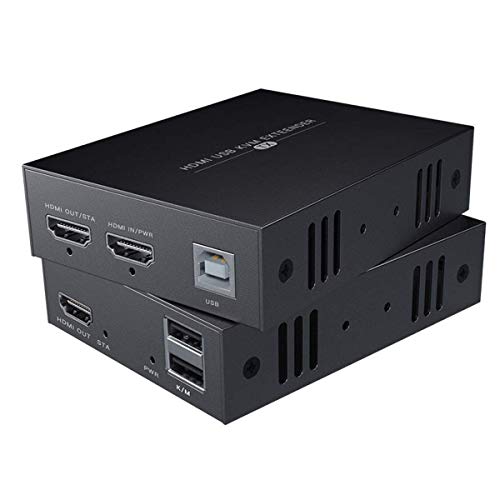
- 1080p at 60Hz over Ethernet
- USB keyboard-and-mouse control
- Mac OS, Windows, and Linux support
Best For: Basic 1080p remote KVM control over up to 50m
Long-Range 4K Home Theater KVM

- 4K60 4:4:4 over a long HDBaseT run
- Supports HDR and advanced audio formats
- Includes USB KVM and two-way IR
Best For: Long-distance 4K HDMI and basic KVM installations
Plug-and-Play 1080p KVM
AV Access 80m USB KVM Extender
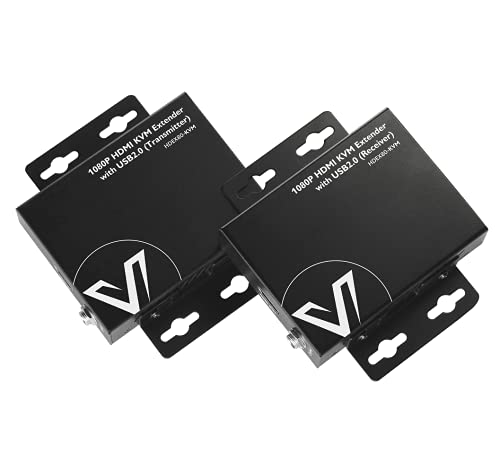
- 1080p60 and USB over up to 80m
- No software or driver required
- Two-way PoE and rugged metal casing
Best For: Long-range, driver-free 1080p Mac KVM control
Best 4K Mac KVM Extender
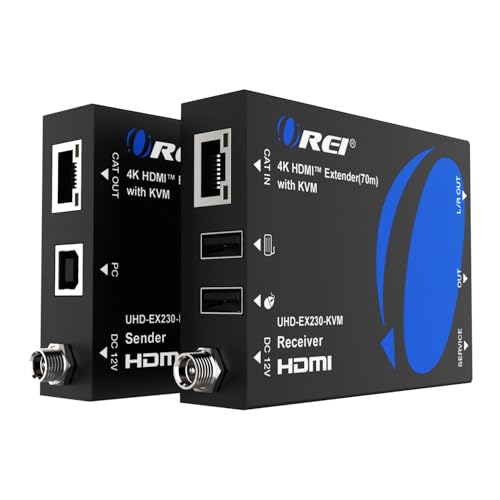
- 4K@60Hz transmission up to 230 feet
- USB keyboard and mouse extension
- HDMI loop-out with HDR and audio support
Best For: 4K Mac workstations and media setups
Best Long-Range VGA Option
TESmart 1080P USB VGA KVM Extender

- Up to 984 feet over Cat5e/Cat6
- Supports 1920×1200 at 60Hz
- Remote keyboard and mouse control
Best For: Legacy VGA Mac and mixed-computer installations
Best Dual-Monitor Mac Extender
Dual 1080p HDMI USB KVM Extender

- Extends two 1080p HDMI displays
- Four USB 2.0 receiver ports
- Mac OS compatible with plug-and-play setup
Best For: Dual-screen Mac workstations up to 197 feet
Best Long-Range 1080p Value

- 394-foot transmission over Cat 5e/6/7
- 1080p at 60Hz with loop-out
- Mac OS compatibility listed
Best For: Long-distance 1080p Mac displays with keyboard and mouse control
Best Networked 4K Choice

- Uses direct Cat cable or Gigabit IP networks
- 4K30 and 1080p120 video support
- Three remote USB 2.0 ports
Best For: Networked Mac workstations and distributed control environments
Simple 1080p Remote Control – 50m HDMI KVM Extender
For shoppers comparing kvm extenders for mac, this HDMI-over-Ethernet kit provides a straightforward way to send 1080p video and USB keyboard-and-mouse control to a remote display. It supports Cat5e, Cat6, or Cat7 cabling, with the longest stated distance available over Cat6/7.
Best For: Mac users who need basic 1080p remote display access and KVM control over up to 50 meters.
Pros:
- Supports 1080p at 60Hz and lossless audio/video transmission.
- Extends HDMI and USB KVM signals up to 50m/164ft with Cat6/7 cable.
- Lists compatibility with Mac OS 9.1 and higher, Windows, and Linux.
Cons:
- Limited to 1080p rather than 4K output.
- Distance is reduced to 40m/130ft when using Cat5e cable.
- The listed Mac compatibility is broad but does not specify newer Apple silicon models.
This is a practical, lower-complexity choice for a single remote 1080p workstation. Choose Cat6 or Cat7 cable if you want the product’s maximum stated range and signal quality.
Triple-Display Mac Docking KVM – Thunderbolt 4 3-Monitor KVM
Among kvm extenders for mac, this DisplayLink-based USB-C KVM is aimed at users who need to switch a triple-monitor workspace between two laptops. It combines display switching with USB peripherals, card readers, Ethernet, and laptop charging, but requires a DisplayLink driver.
Best For: MacBook, Mac Mini, and other compatible Mac users sharing an extended three-monitor setup between two computers.
Pros:
- Supports three simultaneous displays up to 4K at 60Hz.
- Designed to support extended displays on Macs with M1 through M5 processors.
- Includes USB ports, SD/TF readers, Gigabit Ethernet, and up to 50W PD charging for each laptop.
Cons:
- DisplayLink driver installation is required.
- Keyboard hotkeys are not supported; switching uses the button or wired remote.
- Not compatible with Linux/Unix, and full Thunderbolt features such as daisy-chaining are unavailable.
This is the most feature-rich option here for a Mac-centered multi-monitor desk, especially where extended display support matters. Confirm your operating system, install the required driver, and use the included Thunderbolt 4 cables for the intended setup.
Long-Range 4K Home Theater KVM – OREI 400ft 4K HDBaseT KVM
This OREI unit is a long-distance HDMI KVM extender for Mac and other HDMI sources, using HDBaseT over a single network cable. It is specified for 4K60 video, modern HDR formats, audio support, USB KVM, and transmission distances up to 400 feet.
Best For: Long cable runs where 4K video, USB KVM, and broad home-theater audio and HDR support are priorities.
Pros:
- Extends HDMI over HDBaseT up to 400ft/122m according to the product title.
- Supports HDMI 2.0b, 18Gbps, HDCP 2.2, and 4K60 4:4:4 video.
- Lists HDR10+, Dolby Vision, HLG, USB 1.1 KVM, and two-way IR support.
Cons:
- The supplied information identifies a gaming console as a compatible device, so Mac-specific compatibility is not detailed.
- USB KVM is listed as USB 1.1, which is limited for high-speed peripherals.
- Only one HDMI port is specified in the product details.
Choose this model when distance and high-quality 4K video matter more than a compact desktop setup. Mac buyers should verify the computer’s HDMI output and the required USB connections before purchase.
Plug-and-Play 1080p KVM – AV Access 80m USB KVM Extender
For a dependable, no-driver approach to kvm extenders for mac, this AV Access model sends 1080p HDMI and USB 2.0 signals over one Cat5e/6/6a/7 cable. Its extended USB ports are suited to remote keyboard and mouse control, while two-way PoE can reduce the number of power connections.
Best For: Mac users needing plug-and-play 1080p KVM control over a long Ethernet-cable run.
Pros:
- Extends 1080p at 60Hz and USB signals up to 80m/260ft.
- Requires no software or driver and lists Mac OS compatibility.
- Provides two USB 2.0 ports and two-way PoE with one power supply.
- Metal housing helps with durability, EMI/RFI reduction, and heat dissipation.
Cons:
- Output is limited to 1080p rather than 4K.
- USB connectivity is USB 2.0, with speeds up to 480Mbps.
- The recommended power-adapter placement is at the receiver side, which may affect installation planning.
This is a strong practical pick for remote Mac control when ease of installation and reach are more important than high resolution. Its driver-free design and broad cable compatibility make it especially suitable for offices, NVRs, and similar equipment rooms.
Best 4K Mac KVM Extender – OREI 4K HDMI Over Ethernet
For Mac users who need to place a display and USB controls farther from the computer, this OREI model is a capable choice among kvm extenders for mac. It sends 4K video at up to 60Hz over Cat6 or Cat7 cable, while its USB KVM connection supports remote keyboard and mouse control.
Best For: Mac workstations, media setups, and other applications needing 4K video, remote USB control, and a local HDMI display connection.
Pros:
- Supports 4K@60Hz over distances up to 230 feet with Cat6/7 cable.
- Includes USB KVM extension for remote keyboard and mouse control.
- Offers HDMI loop-out, EDID pass-through, HDR support, and 3.5mm audio output.
- Compact plug-and-play design and a one-year warranty.
Cons:
- Requires compatible high-quality Cat6 or Cat7 cabling for the stated range.
- The included power supply uses a North American Type A plug, although an adapter is provided for international use.
This is the strongest fit of the three for a Mac setup where 4K image quality matters. Its 230-foot range and feature set are useful for distributed workstations, though buyers should confirm their Mac and display connections and plan the required network cable run.
Best Long-Range VGA Option – TESmart 1080P USB VGA KVM Extender
This TESmart unit is a practical option for older Mac or mixed-computer environments that still use VGA. Among kvm extenders for mac, it stands out for its stated reach of up to 984 feet over a single Cat5e or Cat6 cable and for carrying keyboard and mouse data to a remote location.
Best For: Long-distance installations using VGA-equipped computers and displays, including legacy Mac or mixed-platform setups.
Pros:
- Supports resolutions up to 1920×1200 at 60Hz.
- Extends VGA and remote keyboard/mouse control over one Cat5e or Cat6 cable.
- Provides a very long stated transmission range of up to 984 feet.
- Includes 8KV ESD protection and a one-year hardware warranty with lifetime technical support.
Cons:
- Uses VGA rather than HDMI, so it is less suitable for newer Mac hardware without the necessary adapters.
- Requires a compatible computer with USB and VGA connectivity and correctly wired EIA/TIA 568B cabling.
Choose this model primarily when legacy VGA compatibility and distance take priority over modern video standards. It can cover an unusually long cable run, but newer Mac owners should verify their adapter setup before buying.
Best Dual-Monitor Mac Extender – Dual 1080p HDMI USB KVM Extender
For a Mac workstation that needs two remote displays, this dual-monitor model offers a straightforward setup. It transmits two 1080p HDMI signals plus USB 2.0 over a single Cat5e, Cat6, Cat6a, or Cat7 cable, with stated Mac OS compatibility and no additional software or drivers.
Best For: Dual-screen Mac workstations that need remote keyboards, mice, storage, cameras, or other USB 2.0 peripherals.
Pros:
- Extends dual 1080p@60Hz HDMI video up to 197 feet.
- Provides four USB 2.0 ports at the receiver for peripherals.
- Works with Mac OS, Windows, and Linux without extra software or drivers.
- PoC allows the receiver-side power supply to power both units through the Cat cable.
Cons:
- Video resolution is limited to 1080p@60Hz rather than 4K.
- USB connectivity is USB 2.0, which may limit faster peripheral transfers.
- The stated operating temperature upper limit is 45°C.
This is the most purpose-built choice here for a dual-display Mac desk. Its single-cable video, USB extension, Mac OS support, and PoC design simplify installation, provided 1080p resolution meets your monitor requirements.
Best 4K PoC Pick – 4K60 USB KVM Extender
For buyers comparing kvm extenders for mac, this AV Access model combines 4K60 HDMI video with USB 1.1 keyboard-and-mouse control over one Cat 6, 6A, or 7 cable. Its 230-foot range and single-power PoC design make it practical for clean installations in offices, classrooms, control areas, and home AV setups.
Best For: Mac users who need smooth 4K60 video, basic remote keyboard/mouse control, and simplified single-adapter installation.
Pros:
- Extends 4K at 60Hz with 4:4:4 support and HDCP 2.3.
- Transmits HDMI and USB 1.1 signals up to 230 feet over Cat 6 or better cable.
- Bi-directional PoC can power both units from one adapter.
- Supports Dolby Atmos, DTS:X, and PCM 7.1 audio.
Cons:
- USB control is limited to USB 1.1 keyboard and mouse signals.
- Requires a compatible HDMI source and a properly installed Ethernet cable run.
This is the strongest option here for high-refresh 4K display extension and tidy installations. The included mounting brackets and compact metal chassis are useful when placing the units behind displays, in lecterns, or in racks.
Best Long-Range 1080p Value – 120M HDMI KVM Extender
This VPFET unit is a straightforward choice among kvm extenders for mac when 1080p resolution and long cable distance matter more than 4K support. It carries HDMI and USB 1.1 keyboard/mouse control up to 394 feet over Cat 5e, Cat 6, or Cat 7 cable and includes a useful local loop-out.
Best For: Mac users extending a 1080p computer signal to a distant display in a classroom, conference room, or home theater.
Pros:
- Supports transmission distances up to 400 feet or 120 meters.
- Handles 1080p at 60Hz and is backward compatible with several lower resolutions.
- Loop-out lets users monitor the signal locally when the display supports 1080p.
- Lists compatibility with Mac OS 9.1 and newer, Windows, and Linux systems.
Cons:
- Limited to 1080p rather than 4K video.
- USB support is restricted to standard keyboards and mice, not gaming peripherals or switches.
- Both transmitter and receiver require separate power connections.
Choose this model for a budget-conscious, point-to-point 1080p setup. Its reset button and status indicators can simplify troubleshooting, but the dual-power requirement makes installation less streamlined than a PoC design.
Best Networked 4K Choice – 4K HDMI KVM Extender Over IP
For kvm extenders for mac in distributed workspaces, this AV Access model sends HDMI video and USB 2.0 control over existing Ethernet infrastructure. It supports direct connections or compatible Gigabit Ethernet switches, giving it more deployment flexibility than a basic point-to-point extender.
Best For: Mac workstations, server rooms, classrooms, and control centers that need remote USB peripherals over a network.
Pros:
- Extends video and USB control up to 394 feet over Cat 5e, or up to 492 feet over Cat 6/6A/7.
- Supports up to 4K at 30Hz and 1080p at 120Hz.
- Can use an existing Gigabit Ethernet network or a direct cable connection.
- Receiver includes three USB 2.0 ports for keyboards, mice, flash drives, and other compatible devices.
Cons:
- 4K output is limited to 30Hz.
- Requires compatible Gigabit Ethernet equipment for switched-network deployments.
- HDCP support is specified as HDCP 1.4, rather than the newer HDCP 2.3 standard.
This is the most flexible pick for installations that need remote USB access beyond a single display location. Its zero-latency design and multichannel audio support also suit real-time control and professional AV applications.
How We Picked the Best Kvm Extenders for Mac
We organized these 10 options around the features that matter most in real Mac setups: video resolution and refresh rate, connector compatibility, USB keyboard and mouse support, transmission distance, installation complexity, and compatibility with common Ethernet cabling. We also considered whether each design supports features such as power over cable, IR control, loop-out video, HDR, dual displays, or network-based extension.
Mac compatibility depends on the computer, dock, adapter, and display chain—not just the extender. A KVM extender that accepts HDMI may require a USB-C or Thunderbolt dock for a MacBook, while a native USB-C or Thunderbolt model can reduce adapters but may have stricter hardware requirements.
Quick Comparison
- Best for basic remote control: 1080p HDMI-and-USB extenders are usually the simplest and most affordable choice.
- Best for sharp modern displays: 4K HDMI models suit office, editing, signage, and productivity setups.
- Best for multiple screens: Choose a dual-monitor extender or a Thunderbolt 4 KVM dock with sufficient bandwidth.
- Best for long distances: HDBaseT and purpose-built long-range systems can reach roughly 230 to 984 feet, depending on the model and cable.
- Best for flexible infrastructure: Extenders operating over Cat5e, Cat6, Cat6a, or Cat7 can use structured cabling already installed in a building.
Key Buying Factors for Kvm Extenders for Mac
Mac Ports and Signal Format
Check whether your Mac provides HDMI, DisplayPort, USB-C, or Thunderbolt output. If the extender uses HDMI, verify that your adapter or dock supports the desired resolution and refresh rate. Apple-silicon Mac models can also differ in external-display support, so confirm the computer’s native monitor limits before buying a multi-display solution.
Resolution, Refresh Rate, and HDR
1080p is adequate for remote administration, point-of-sale systems, and basic office work. For detailed creative work or large monitors, look for 4K at 60Hz. HDR10 support can improve compatible video, but every component—including the Mac, adapter, extender, cable, and display—must support the same format.
Distance and Cabling
Use the manufacturer’s distance rating as a planning maximum, not a guarantee for every installation. Cable quality, termination, interference, wall plates, and network equipment can reduce performance. Many point-to-point extenders require a direct cable run rather than a shared managed network; read the installation instructions carefully.
USB and Control Features
Confirm that the product extends the USB signals you actually need. Some support only keyboard and mouse, while others may handle additional USB peripherals. Features such as PoC, loop-out, two-way IR, and plug-and-play pairing can simplify installation, but they do not replace checking power, EDID, HDCP, and operating-system requirements.
Who Should Buy Which Kvm Extenders for Mac?
Choose a compact 1080p model if you need dependable keyboard-and-mouse control for a remote Mac mini or office workstation. Pick a 4K HDMI extender for a home office, studio, or conference room where image clarity matters. A dual-monitor unit is better for productivity users who need extended desktop space, while a Thunderbolt 4 KVM dock is the most appropriate fit for compatible MacBooks and multi-display USB-C workflows.
For server rooms, classrooms, and commercial installations, prioritize distance ratings, HDBaseT or IP architecture, cable standards, and serviceability over the smallest price. If you are unsure, measure the complete cable path, identify every adapter in the signal chain, and select an extender with resolution and bandwidth headroom.